Vollering Won Her First Road World Title, Then Retained Her European Crown
Demi Vollering won the women’s elite road race at the UCI World Championships in Montréal on September 26, then retained her European title in Slovenia on October 3.
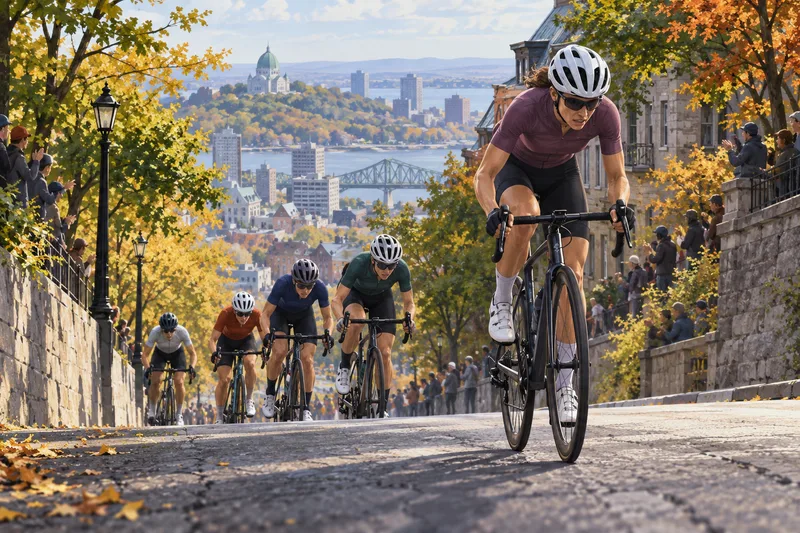
Demi Vollering won her first elite road world title in Montréal on September 26, then retained her European crown in Slovenia on October 3. The races were seven days apart, but each had a different route and tactical pattern. The UCI and UEC reports show how teammates helped create the decisive moves in both wins.
Montréal’s repeated climb shaped the world race
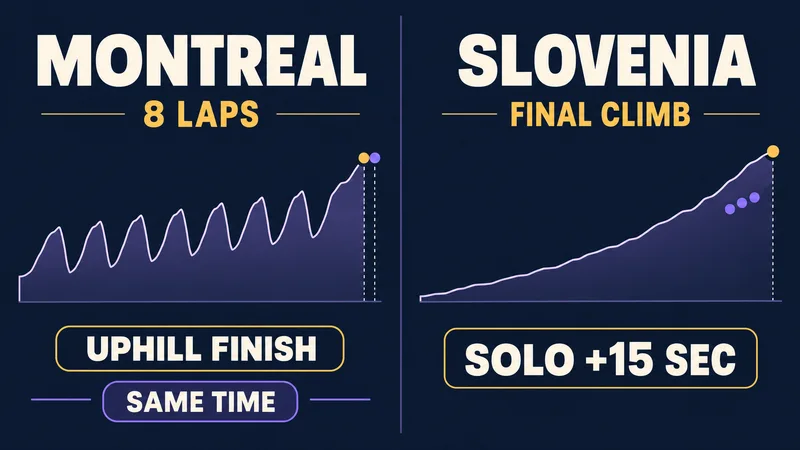
The women’s elite road race covered 180.1 kilometres on the Montréal course. Riders completed eight 13.4-kilometre laps around Mont-Royal, each taking them over Voie Camillien-Houde, a 1.67-kilometre ascent averaging 7.4 percent and reaching 10 percent at its steepest. The circuit made it difficult to settle the race with one early move: attacks could be tested again on the next climb.
The Dutch squad controlled the field behind the early escape, which the UCI identified as Gergana Stoyanova of Bulgaria, Beatriz Roxo of Portugal, Marte Berg Edseth of Norway and Natalie Quinn of the United States. The break had a lead of around three minutes as it entered the final circuit. A mass crash then affected the peloton and included defending champion Magdeleine Vallières Mill and Spain’s Paula Blasi. The race changed again with 52 kilometres remaining, when France’s Maeva Squiban moved to the front. The Dutch riders organized the chase. On the next ascent, Puck Pieterse launched Vollering’s attack 38.5 kilometres from the finish.
Vollering caught Squiban and continued alone. The chase group kept the gap under pressure, and Kasia Niewiadoma-Phinney, Elisa Longo Borghini, Marlen Reusser and Juliette Berthet came back before the final circuit. The UCI says the decisive fight came on the uphill final straight. Vollering and Niewiadoma-Phinney were recorded in the same time, with Longo Borghini four seconds behind and Reusser, the newly crowned time-trial world champion, fourth at eight seconds. The same recorded time did not make it a tie: the UCI placed Vollering first across the line. Vollering later said the chase closed at one point and she had to try again rather than assume her first move would last. The gap shifted from around 20 seconds to 22 and then 15; she also admitted she wondered whether she had gone too early. That account helps explain why the last lap remained contested.
Why Montréal was a first
The world title was Vollering’s first in the women’s elite road race. Before Montréal, she had won silver and bronze in the individual time trial at the 2024 and 2025 World Championships and bronze at the 2023 UCI Gravel World Championships. The UCI called her the ninth Dutch winner of this road race and counted 15 victories by September 26. The list included the Tour of Flanders, La Flèche Wallonne, Liège-Bastogne-Liège, the 2026 Giro d’Italia Women and Tour de France Femmes. She had won the Tour de France Femmes in 2023 and La Vuelta in 2024 and 2025.
Those earlier results spanned different disciplines and formats. Montréal was an elite mass-start road race where the Dutch team could shape the chase and Pieterse could help set up Vollering’s attack; her time-trial medals came from individual efforts against the clock. That distinction explains why the rainbow jersey was a new achievement despite the breadth of her season.
Slovenia required another well-timed move
Both the World Championships and the European Championships were one-day national-team road races, but the awards are separate: Montréal gave Vollering the rainbow jersey, while Slovenia was a defense of the European title she had already won in 2025. One week later, she raced for that continental crown on the Šenčur course in Slovenia. The UEC report says Austria’s Kathrin Schweinberger and Belgium’s Margot Vanpachtenbeke built an early lead of around two minutes while the Dutch team controlled the peloton. The first slopes of the Možjanca climb reduced the main group to several contenders.
Cecilie Uttrup Ludwig and Franziska Koch moved ahead during a lull but were caught at the start of the final lap. A later attempt by Femke de Vries, Noemi Rüegg and Liane Lippert was also brought back. On the last climb, Pieterse accelerated and split the remaining riders, setting up Vollering’s attack. The group chasing Vollering included Marlen Reusser, Elisa Longo Borghini, Antonia Niedermaier and Katarzyna Niewiadoma, but she timed the move well, built a gap and held it to the finish in Šenčur.
She won solo, 15 seconds ahead of Pieterse, with Reusser taking bronze. The UEC described the result as Vollering’s second consecutive European title and the Netherlands’ tenth in eleven editions.
Two titles, two race patterns
The finishes show the difference: Montréal ended on an uphill final straight, with Vollering and Niewiadoma-Phinney recorded in the same time; in Slovenia, Vollering finished alone, 15 seconds ahead of Pieterse.
Sources & further reading
- 2026 UCI Road World Championships: Vollering takes her rainbowUnion Cycliste Internationale (UCI) · accessed Oct 12, 2026
- EUROROAD26: Vollering gold again, Dybing junior kingUnion Européenne de Cyclisme (UEC) · accessed Oct 12, 2026
- Results Thread: 2026 World Championship Road Race - WomenReddit, r/peloton · accessed Oct 11, 2026