UK Trade Statistics Get a Transparency Upgrade: What Changed in October 2026
The ONS October 2026 update records four areas of work on UK trade statistics: revisions and uncertainty in services estimates, trade asymmetries, consolidated quality information, and rebuilt production systems. Most of the changes concern how much users can trust the numbers rather than new headline figures.

What this update is
The UK's statistics agency has published its October 2026 update on improving trade statistics, and most of the changes are about telling users how much to trust the numbers rather than publishing new headline figures.
The work sits under the UK Trade Development Plan, first published in 2022, and it lands against a background of statistical errors in trade data that HMRC reviewed separately. The ONS lists revision transparency as one of four work areas; the HMRC review separately informed recommendations for quality-assurance controls.
Four areas of work
The ONS groups progress into four connected areas.
The first is revisions and uncertainty in trade in services estimates. Services are surveyed, so early estimates rest on incomplete responses and get revised as more data arrives. Since 16 April 2026 the monthly UK trade bulletin has carried a standing revisions section explaining where revisions appear, how they affect published estimates and why they happened.
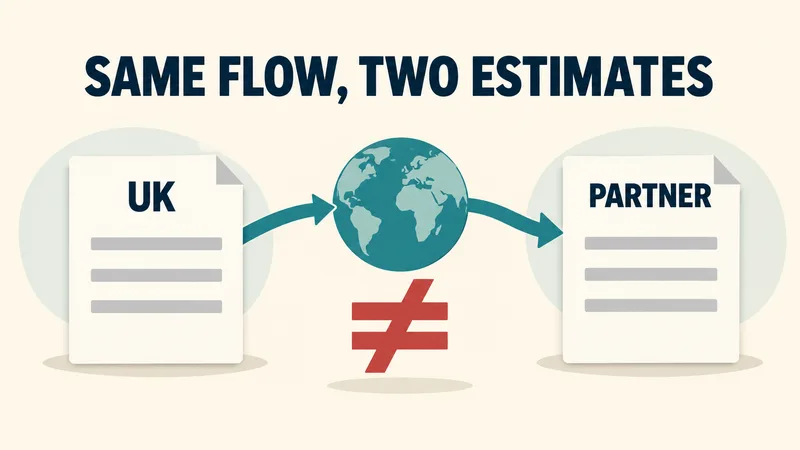
The second is trade asymmetries, which occur when the UK and a partner country report different numbers for the same flow. Countries use different sources, methods, classifications and recording practices, and they sometimes record a transaction in different periods. On 10 April 2026 the ONS published a user guide to international trade statistics and trade asymmetries, and on 10 August 2026 it published a dataset and bulletin on services asymmetries by partner country and service type.
The third is quality and methodology information. The UK trade quality and methods guide was revised on 16 January 2026, gathering material that had been spread across separate documents.
The fourth is systems and resilience: the ONS is redeveloping the systems that produce trade in goods and international trade in services statistics while adding controls to the existing ones.
Revisions, and why they are now shown
The most concrete change for anyone using these numbers is the revisions analysis.
Separate revisions triangles for services imports and exports were introduced in March 2026, with a dataset for each. The series go back to 2018 and show how the estimate for the same period changes across successive publications, which makes the lifecycle of a number visible instead of leaving it in a methodology note.
The bulletin also publishes monthly and rolling three-month estimates side by side. The rolling view is meant to give a steadier read when a monthly figure is volatile or based on less complete data.
Asymmetries: two countries, two numbers
Trade asymmetries are the second half of the transparency problem. If the UK reports exporting a service to a country that reports importing less, both figures can be genuine and still disagree.
The April 2026 guide explains why that happens, and the August 2026 dataset quantifies the differences by partner country and service type. For anyone comparing bilateral trade figures, the practical effect is that a country-level comparison should now be read against the asymmetry evidence rather than on its own.
Quality information in one place
The revised quality and methods guide consolidates what the statistics cover, how they are produced, and where the limitations sit. Further work will clarify what data is available at each stage of the services estimation process, so users can separate early estimates from mature ones.
The distinction matters because the ONS says early services estimates carry uncertainty and are revised as more complete survey and administrative data become available.
Systems, staffing and the HMRC review
The production side is less visible and explains the rest. The ONS is building replacement systems for goods and services statistics and, in parallel, adding quality assurance controls to current processes.
It has set up a flexible resourcing team, created a specialist trade expert role, completed end-to-end process maps and quality assurance documentation for both systems, and expanded a Continuous Improvement team established in 2024 and grown in 2025 with investment from the Economic Statistics Plan.
The update also records joint work with HM Revenue and Customs after HMRC's review of recent statistical errors affecting trade data. The joint workshops identified four areas for stronger quality assurance: enhanced aggregate-level checks, greater use of time-series analysis, stronger governance of Customs Procedure Code changes and better visibility of upstream system changes.
Those are recommendations HMRC set out in its own review, and the ONS says it is working through the remaining ones.
What ties it together
The ONS frames the work against the Office for Statistics Regulation's May 2025 review of UK trade statistics, which set four requirements covering uncertainty and revisions, asymmetries, quality information, and production resilience. The October update presents each area of work as answering one of them.
What is still to come
A fuller analysis of revisions to early services estimates is promised, including work on potential bias already shared with the Office for Statistics Regulation. Its findings are expected to explain what the behaviour of early estimates means for quarterly and annual numbers.
The quality guide will be updated as methods change, and further automation and quality assurance work is planned for the services systems.
The useful takeaway is procedural rather than numerical. Anyone quoting UK trade figures should read the revisions section in the monthly bulletin, check whether an estimate is early or mature, and treat a bilateral comparison as something to be read alongside the asymmetry dataset. The update makes those steps easier; it does not make the estimates more certain than they are.
Sources & further reading
- UK trade development plan update: October 2026Office for National Statistics · accessed Oct 12, 2026
- UK trade development plan update: October 2026 (release page)Office for National Statistics · accessed Oct 12, 2026