TypeSafe's System One Models and Jev: Typed Decisions Instead of Generated Text
TypeSafe announced System One Models and opened early access to Jev on September 15, 2026. Jev is a documented API that returns typed decisions with calibrated confidence instead of generated text, and it carries a published price, published limits and a published list of failure modes.

What TypeSafe released on September 15
On September 15, 2026, TypeSafe AI announced System One Models and opened early access to Jev, the first public model in that class. The founder's announcement describes Jev as a frontier model that returns typed decisions instead of generated text, and the company's documentation now publishes the endpoint, the price and the limits that go with it.
For a developer the short answer is an API that takes a state and a map of typed questions and returns typed answers with probabilities and a confidence score. It does not write replies, produce code, or explain its reasoning, and the documentation says it accepts text only.
The interface is a function call, not a chat
TypeSafe describes a System One model as a model built to make fast, structured decisions that software can use directly. A request sends a state and typed questions; the model returns typed values, with no text generation or parsing on the caller's side. The documentation calls its three question types primitives.
- Choice returns
choice,probabilitiesandconfidence. - Score returns
score,legend,probabilitiesandconfidence. - Noul answers a yes or no statement with a number between 0 and 1.
All three can be asked in one request, and every question is evaluated against the same state in parallel and in isolation, so adding questions barely changes response time. The endpoint is POST https://api.typesafe.ai/v1/systemone with a bearer token, and the request carries state, model and questions.
What developers can run today
The current model is jev-1.13.0, reachable through the jev-latest alias, which is also the default in the client SDKs. Python developers install typesafe-sdk, JavaScript developers install the TypeSafe SDK package, and both clients handle retries with backoff by default. The HTTP API is open to any language.
The published numbers are specific. Input costs $42 per billion tokens, or $0.042 per million, and output tokens are free because the model does not generate text. Rate limits are 100,000 tokens per second and 80 requests per second, and a request over either limit returns a 429. One request carries up to 64k tokens, of which the state plus the longest question can take 32k.
Rate limits are adjusting dynamically and can change without notice while the company adds capacity; higher limits sit on custom and enterprise plans. Input is text only: strings, JSON objects, or arrays of text. Images, audio and video are not supported yet, and non-text input has to be converted to text before it is sent.
Jev is not fine-tuned per account. The same weights serve every customer, and the documentation says the model is not trained on customer requests or responses. Domain behavior is steered through the state and through the instructions and criteria of each question rather than through per-account weights.
The format claim versus the accuracy question
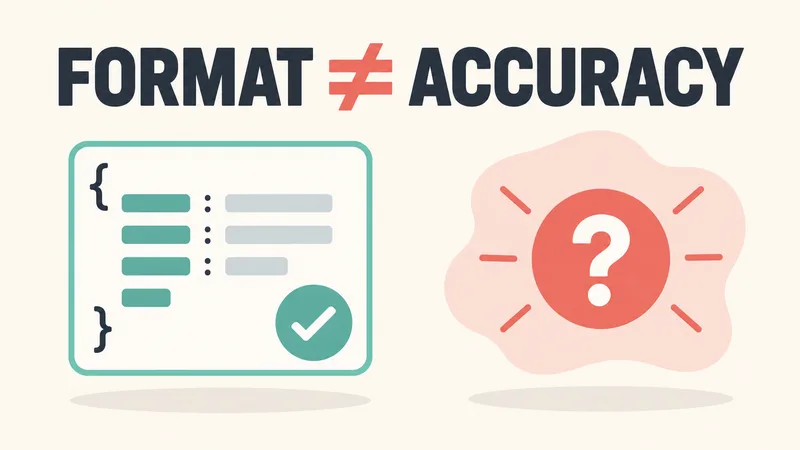
TypeSafe publishes an error table that lists a 0.00 percent structured-output error rate and a 0.00 percent tool-call error rate for Jev, against higher numbers for several current models, and the homepage labels the section zero hallucinations. The announcement says Jev cannot hallucinate.
The documentation draws the line more carefully. Calibration is measured across groups of predictions and does not guarantee that an individual answer is correct, and the schema guarantee is about matching the defined output structure. Both statements can hold at the same time, and the difference matters to anyone who plans to branch on a Jev answer without a check.
The company's own limitations page is more useful than either claim. It lists nine known failure modes for jev-1.13, including literal reading of instructions, unreliable counting, weak numeric judgement, difficulty with date and time comparison, trouble with indirection, degradation on large states, sensitivity to adversarial content, contradictory instructions and criteria, and sensitivity to the order of choice options. The page recommends moving arithmetic and counting into code and reordering options to check whether an answer is stable.
Choice supports a cardinality up to 255, and above that TypeSafe uses a two-stage system of scoring and then choosing.
Access, evidence and open questions
Access is where the two official pages disagree. The announcement says Jev is available in early access and that the company is bringing developers off the waitlist as quickly as it can. The homepage FAQ states that Jev is now available to everyone and links to account creation. The console sat behind bot protection when this article was written, so the exact onboarding path could not be checked.
The performance claims are TypeSafe's own measurements. The announcement reports 70ms to 500ms per call and 40x to 200x faster for System One shaped queries, and the homepage leads with 193.6x faster and 444.6x cheaper based on its workflow evals. The announcement notes that those workflow results use the average of two reference models as the answer key and that they are likely on the higher end of real world gains.
The company also says it deliberately does not publish results against public benchmarks and plans to run one-off evals only when it ships product updates. No independent benchmark of Jev was found for this article.
What to check before building on it
System One models and Jev are a documented API with a published price, published limits and a published list of failure modes, and they are a different tool from a chat model. The design fits classification, routing, scoring, extraction and confidence-gated branching. It does not fit open-ended generation, arithmetic or counting, and the documentation recommends decomposing broad judgements into atomic questions and combining the results in code.
Three things remain open. There is no independent evaluation of the accuracy claims. The sustainability of the price is unproven, and the company says it cannot prove the price is not subsidized and will need time to show that it is. And the published error table names Jev-1.0 while the documentation serves jev-1.13.0, so the error numbers and the served version are not necessarily the same model. A developer evaluating Jev should build a small set of labelled examples from their own traffic, set confidence thresholds against those examples, and test the known failure modes directly rather than trusting one published percentage.
Sources & further reading
- Introducing System One Models & JevTypeSafe AI · accessed Oct 12, 2026
- ModelsTypeSafe AI documentation · accessed Oct 12, 2026
- System OneTypeSafe AI documentation · accessed Oct 12, 2026
- Primitives (Questions)TypeSafe AI documentation · accessed Oct 12, 2026
- ConfidenceTypeSafe AI documentation · accessed Oct 12, 2026
- API referenceTypeSafe AI documentation · accessed Oct 12, 2026
- Quick startTypeSafe AI documentation · accessed Oct 12, 2026
- TypeSafe Python SDKTypeSafe AI documentation · accessed Oct 12, 2026
- Client SDKsTypeSafe AI documentation · accessed Oct 12, 2026
- typesafe-sdk on PyPIPyPI · accessed Oct 12, 2026
- @typesafe-ai/sdk on npmnpm registry · accessed Oct 12, 2026
- typesafe-ai/typesafe-sdk-jsGitHub · accessed Oct 12, 2026
- Jev 1.13 jaggednessTypeSafe AI documentation · accessed Oct 12, 2026
- TypeSafe AI home pageTypeSafe AI · accessed Oct 12, 2026