A 125B Model on a 12 GB Card: What Strata Requires and How Fast It Runs
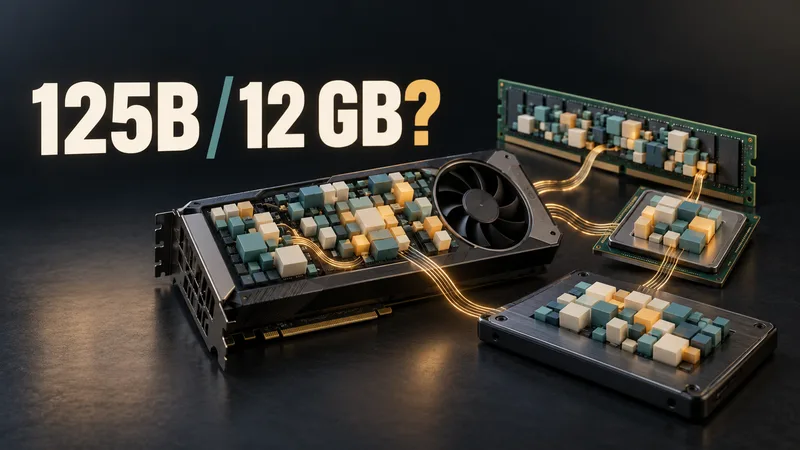
Strata is an open source engine that runs the 125-billion-parameter Qwen3.8-Flash-Next model on a consumer PC with a 12 GB graphics card and 32 GB of RAM, splitting experts across GPU, memory, CPU and SSD. Its own benchmarks report 53 to 94 tokens per second, with clear tradeoffs in model size.
What Strata claims to do
An open source project called Strata says it can run a 125-billion-parameter model on an ordinary gaming PC, using a graphics card with 12 GB of video memory and enough system RAM. The model is Qwen3.8-Flash-Next, a mixture-of-experts model that would normally sit on a server with hundreds of gigabytes of GPU memory.
The project is not a hosted service. You download it, run an installer, download the model, and a browser interface opens on your own machine.
That is the selling point for anyone who does not want prompts leaving the building, and it is also a claim to separate from measured facts. "Nothing leaves your PC" is the project's own description of how it runs, not an independent audit.
What you need
The published requirements are specific, and they are the first thing to check before believing the headline.
You need an NVIDIA GeForce RTX 20, 30, 40 or 50 series card, or one of a listed set of AMD cards, with 12 GB of VRAM or more. You need 32 GB of system RAM or more, about 80 GB of free disk space, and Windows 10 or 11 or Linux with a current driver.
The model download is around 70 GB. The installer walks through model size, context length and image support, then starts the model behind a browser app.
While the model loads, the PC can slow down or stop responding for one to three minutes, according to the documentation. Strata loads 35 to 55 GB into RAM and locks part of it for the graphics card. The project tells users to wait rather than close the window.
The speeds the project measured
Strata publishes its own benchmark tables from two machines: an NVIDIA RTX 5070 with 12 GB, a Ryzen 5 7600 and 64 GB of RAM, and an AMD RX 9070 XT with 16 GB, a Ryzen 9 3900X and 47 GB of RAM.
On the NVIDIA machine, the smallest quantisation writes answers at 94 tokens per second and reads a prompt at 2,650 tokens per second. The largest of the listed sizes, IQ3_S, writes at 53 and reads at 1,620. On the AMD machine, the smallest writes at 60 and reads at 1,160.
Tokens are roughly three-quarters of a word, so 60 tokens per second is faster than most people read.
These are the project's measurements on its own hardware rather than a third-party test, and the numbers depend on quantisation size, context length and what else the machine is doing. The project publishes a fuller table and asks users to run its benchmark and share results.
The tradeoff hiding in the sizes
The same model ships in several compressed sizes. The documentation says smaller versions are faster and a bit less capable than the original model.
The most interesting entry is Coder, a version with half of the model's experts removed. The project says it reaches 91% of the full model's SWE-bench Verified score, measured by its authors, and fits in 32 GB of RAM. The stated catch is that it is weaker outside code, including Chinese and other CJK text, where the project recommends the full-expert sizes instead.
That is the pattern to keep in mind: the headline capability and the configuration that makes it fit are not the same configuration.
How it fits on a small card
The explanation is a mixture-of-experts design. The model contains 24,576 small specialist networks, and each token routes through only about ten of them.
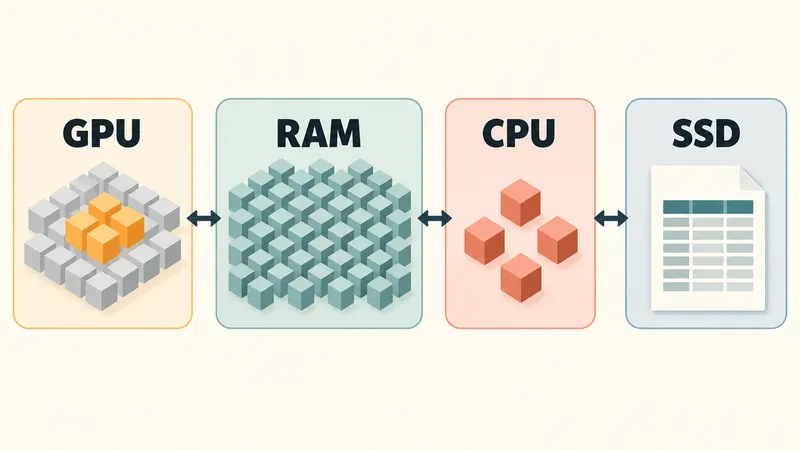
Strata splits the work across the machine. The graphics card keeps the few thousand experts used most often, system RAM holds all of them, the processor handles the rest, and the SSD stores a large lookup table. The documentation describes the trade as a kitchen: what you use constantly stays on the counter, and the rest waits in the pantry.
A second technique is described as guess and check. A smaller helper model guesses the next few words, and the large model checks the candidates in one pass, which the project says makes answers appear 1.6 to 1.8 times sooner. Long inputs are read in blocks of up to 8,192 tokens at more than 1,000 tokens per second.
What you get once it runs
The interface includes a chat panel, a live monitor for the model and machine, and a settings view. For applications, Strata exposes an OpenAI-compatible endpoint at a local address, an Anthropic-style messages endpoint, and the Responses API used by some coding agents, so existing tools can point at it instead of a cloud provider.
Reasoning effort can be set from off to high, images can be enabled during setup, and the project documents multi-GPU setups, a benchmark script, and community-tested configurations for older cards, Intel Arc and AMD Strix Halo hardware.
What the documentation does not promise
Two practical limits are stated plainly. By default Strata answers one request at a time and queues the others unless parallel handling is enabled, and enabling it slows each answer on a 12 GB card. Reading a long first message takes roughly a minute per 30,000 tokens, with follow-up messages starting in seconds.
Images also work differently by platform: AMD cards read pictures through the processor on Linux and cannot on Windows yet.
Sources & further reading
- Strata repository READMEStrata project (MIT licence; model by the Qwen team; quantisations by ISTA-DASLab, UkisAI and Unsloth) · accessed Oct 12, 2026
- Qwen3.8-Flash-Next model page (referenced, not opened)Qwen team · accessed Evergreen guide