RSD Black Friday 2026: The Release List, the Pressing Numbers and the Store Rules
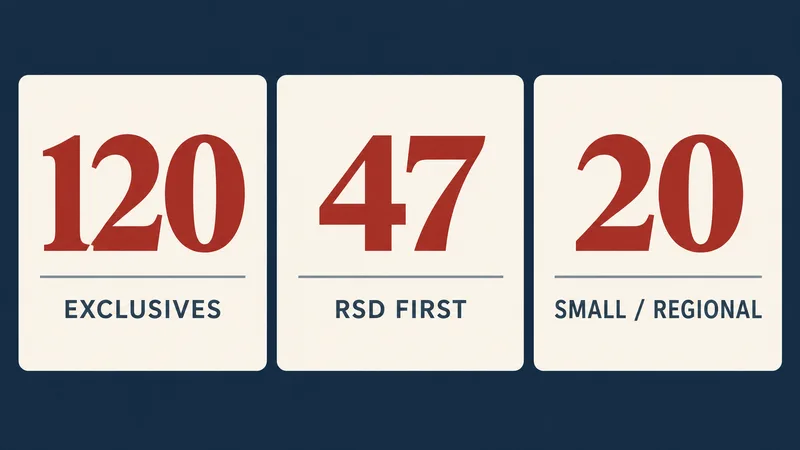
Record Store Day has published its Black Friday 2026 release list for a sale on Friday, November 27. When the list page was checked on October 12 it counted 187 rows across four pages, split into 120 store-only Exclusives, 47 RSD First releases and 20 limited or regional titles, with pressing runs from 250 copies to 14,500. Record Store Day says titles can still be added, dropped or moved, and United States stores cannot sell the titles online before the morning of Saturday, November 28.

Record Store Day has published its release list for RSD Black Friday 2026, and the sale is on Friday, November 27, the day after Thanksgiving. When the list page was checked on October 12 it counted 187 rows across four pages, with artwork on each entry and a printable PDF wish list alongside the web version. Those figures are a snapshot. Record Store Day says titles can be added, dropped or moved to another date, so the count and every number below it can change before the sale.
November's event is separate from April's Record Store Day rather than a second copy of it. The organization's Black Friday FAQ says the list is shorter by design: April is the worldwide celebration of the record store, while Black Friday is meant to open the holiday shopping season at independent shops.
Three release types decide where a title can be sold
Every entry is sorted into one of three categories. Exclusives are physically released only at independent record stores. RSD First titles appear at independent stores first but may reach other retailers or webstores later. Small run and regional titles are either sold through specific stores in one region or pressed in runs under 1,000 copies, and Record Store Day describes them as harder to find around the country.
Most of the list is vinyl, but not all of it. Formats include 2 x LP, 3 x LP and 4 x LP sets, a 10 inch EP, 12 inch singles, a picture disc and a 2 x CD set in Frank Black's Teenager of the Year.
What the pressing numbers count
Each row carries a pressing quantity. Record Store Day says the runs shown on its site are the number available in the United States, and that labels and distributors supplied the details.
On the first of the list's four pages, the column ran from 450 copies to 7,000 on October 12. The Doors' 1966 sits at 7,000, the Eagles' Please Come Home For Christmas/Funky New Year 12 inch single at 6,000, and several titles at 5,000, among them The B-52s' Meso-Americans Live 1982, Benson Boone's Walk Me Home and a release from the K-pop group Cortis. Further down are Genesis's Land of Confusion picture disc at 1,850 and Doctor Who's The Rising Night, a limited or regional title, at 1,000. The lowest figure on that page, 450, belongs to Lynn Blakey's Dreams Are Lovers retrospective.
A run size describes how many copies exist in the United States, not how many reach one shop. Record Store Day warns that a store may receive fewer copies than it ordered and that a title can sell out before a customer reaches the counter.
How the list divides up
As of the October 12 check, the 187 entries split into 120 Exclusives, 47 RSD First titles and 20 small run or regional titles. Vinyl carried most of it: 153 entries listed an LP or vinyl format. Five rows listed no format at all. The remaining entries include eight seven inch singles, five twelve inch singles, two twelve inch picture discs, a ten inch EP, ten CD releases, a record player bundled with an exclusive seven inch single, and two figures, one of Iron Maiden's Eddie and one of Motorhead's Lemmy.
Pressing runs across the full list started at 250 copies, for Oscar Rossignoli's Mar Adentro, an LP filed under limited run or regional titles, and reached 14,500 for a four LP Bruce Springsteen and the E Street Band set recorded at Philadelphia's Tower Theater in 1975.
The Pledge mark, and why a store may skip a title
A shop appears on Record Store Day's participating-store search only if it has signed up, and the FAQ adds a second mark. A store with a P next to its name on recordstoreday.com has signed the Pledge and can bring in Black Friday titles if it chooses. The Pledge applies to stores in the United States.
Record Store Day does not give or sell the releases to stores and does not require them to order anything. Each shop chooses which titles to buy, so two stores in the same city can carry different parts of the list, and the store search page tells customers to check with the shop directly.
Readers outside the United States take a different route: the country's own Record Store Day site, or the local store. The FAQ says Black Friday remains an American retail event while a growing number of countries take part, and that Record Store Day has no control over which titles appear in which country.
Online sales start on November 28 at the earliest
Stores choose whether to sell Black Friday titles on their own websites or through marketplace accounts such as rsdmrkt.com. The FAQ sets one limit. To keep the first day for local customers, the earliest United States stores can sell online is the morning of Saturday, November 28. Some stores will not sell online at all, and others may restrict shipping or pickup areas.
Titles that move, drop off or get added
The list can change, which is why the counts above are dated. Record Store Day says a title may move from November 27 to another date, that titles may be added or dropped, and that details may be amended. The FAQ calls these street date bumps and says the site will carry as much information as it can about a rescheduled title.
Each web entry publishes the title, artist, label, format, release type and pressing quantity with artwork. The list carries no prices and no store-level inventory, so the pressing figure is the most concrete thing a buyer can compare between titles. It says nothing about what any one shop will have.
Why the list cannot promise a copy
A wish list can only be checked against what a shop actually ordered. Stores may keep Black Friday titles through the holiday season while supplies last, so a title that sells out on November 27 can reappear later, and one that a nearby shop never ordered will not be there on the day.
Record Store Day also states that it does not own or produce the releases, with a few exceptions, so each entry's details come from the label or distributor that supplied them and can be corrected later. A title that disappears from the list has been rescheduled rather than cancelled, according to the FAQ.
Sources & further reading
- RSD BLACK FRIDAY 2026 // VIEW THE LISTRecord Store Day · accessed Oct 12, 2026
- THE BLACK FRIDAY FAQRecord Store Day · accessed Oct 12, 2026
- SpecialReleases | RECORD STORE DAY (Black Friday 2026 list)Record Store Day · accessed Oct 12, 2026
- Stores | RECORD STORE DAYRecord Store Day · accessed Oct 12, 2026
- RSD BLACK FRIDAY LIST 2026 Releases - 11/27/26Reddit (r/VinylReleases) · accessed Oct 12, 2026