QSSR on PS5: Two Games So Far, and a Frame-Time Cost That Depends on the Mode
Sony announced QSSR on October 1 and patched Marvel's Wolverine and Ghost of Yōtei the same day, bringing a lighter tier of the PS5 Pro's AI upscaling to the standard console. Insomniac's patch note says Wolverine has it on by default while Sony calls it a graphics option, and the only published measurements put the cost at roughly 1.5ms to 4.4ms of frame time depending on the resolution target.
Sony announced QSSR on October 1, 2026, and the first two games to receive it were patched the same day: Marvel's Wolverine and Ghost of Yōtei. QSSR stands for Quick Spectral Super Resolution, and it is a lighter tier of the AI upscaling that has been exclusive to the PS5 Pro, which means the standard console now runs machine learning image reconstruction in two titles.
The two announcements of that change do not use the same words. Insomniac's patch notes for Marvel's Wolverine say the game uses QSSR on PS5 "on by default", while Sony's post describes both games as offering QSSR "as an additional graphics option on PS5".
The PlayStation Blog post is credited to Daniel Craig, a principal engineer in graphics R&D at Sony Interactive Entertainment. It describes QSSR as a new performance tier of AI upscaling, born from Project Amethyst, Sony's AI graphics collaboration with AMD.
What Sony changed to reach the base console
PSSR, the upscaler that shipped with the PS5 Pro, analyzes game images pixel by pixel and uses AI to upscale them with more detail and stability than older methods. Sony says its computational demands made bringing that experience to the PS5 impossible until now.
QSSR is the version that fits. Sony names two changes: a streamlined neural network architecture, and a hand-tuned implementation that makes the most of the PS5's performance. Digital Foundry, which had around six hours with the technology before the announcement and spoke to Sony about it, reports the hardware difference underneath. The PS5 Pro has dedicated machine learning silicon and runs PSSR with INT8 instructions, which the base console does not support, so QSSR relies primarily on FP16 math, with packed math instructions used extensively to recover efficiency.
Craig gave the gap a figure in the Digital Foundry interview: the PS5 Pro has 300 TOPS of dedicated hardware for this purpose, so it can pick a more generous point on the cost-versus-quality curve. On the base console he describes the aim as a spot developers can afford while still improving on standard temporal anti-aliasing, and he calls keeping the pipeline full the real challenge. Sony also states that PSSR remains the gold standard on the PS5 Pro, which is where the two consoles separate.
The two launch titles, and one difference in the wording
Insomniac's support page for Marvel's Wolverine update 1.002.000 says the game "now uses QSSR for improvements to both image details and image stability on PS5". The patch list under it is explicit: "Uses QSSR on PS5, on by default." The same update covers crash and progression fixes, UI and Photo Mode issues, out-of-bounds and visual polish problems, accessibility items and localization. A later update, 1.002.001, adds a toggle for story-related scent trails and has nothing to do with upscaling.
Ghost of Yōtei is the second title. Sony's post says both games were patched on October 1, and the two studios supplied quotes for it. Mike Fitzgerald, head of technology at Insomniac, describes QSSR as adding pixel-level clarity and stability to Wolverine's environments. Jasmin Patry, lead rendering engineer at Sucker Punch, says QSSR resolves fine detail with a level of temporal stability that had not been possible on the PS5 console.
As of October 12, Sucker Punch's public patch notes list no QSSR entry for Ghost of Yōtei, so the safe reading is the one Sony published: it is an option in the game's graphics settings.
What one hands-on test measured
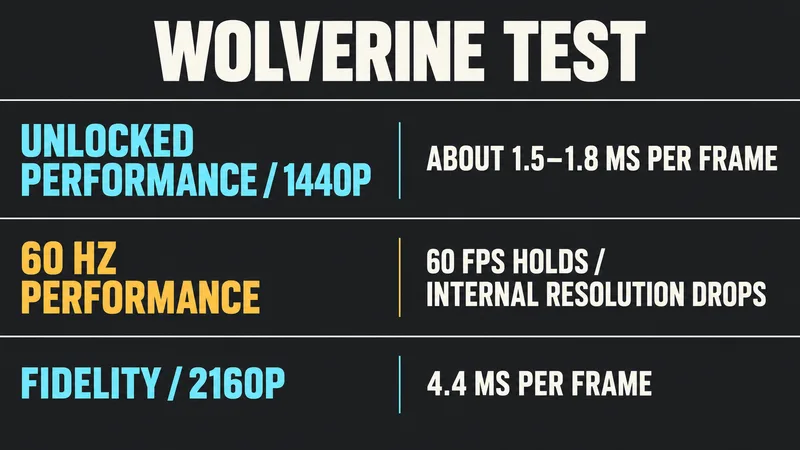
Digital Foundry's measurements are the only published numbers for QSSR so far, and they are mode dependent. In Marvel's Wolverine, running performance mode uncapped with variable refresh rate, QSSR cost about 1.5 to 1.8 milliseconds more per frame than Insomniac's own upscaler while reconstructing from 864p to 1440p, which worked out to an 8 to 10 frame per second difference.
The 60Hz performance mode behaves differently because dynamic resolution scaling holds the frame rate at 60. There, the internal resolution drops to make room for QSSR, the output frame rate stays close to the same, and the image comes out cleaner. The reconstruction target is doing most of the work in that result.
Fidelity mode is the expensive case. Targeting 2160p with an uncapped frame rate, the frame-time cost measured 4.4 milliseconds, with the same 8 to 10 frame per second gap. The outlet's conclusion is that 1440p suits QSSR better, which is the output resolution a lot of lower-resolution PS5 games already aim for.
For scale, the same outlet measured PSSR on the PS5 Pro at roughly 2 milliseconds to reconstruct to 4K. On image quality, its hands-on report found substantially better temporal stability, more resolved detail and fewer artefacts in moving foliage, with the clearest gains in Marvel's Wolverine. Ghost of Yōtei improved less, which the report attributes to that game already holding up well.
What is still open
Sony says QSSR will be offered broadly to all PlayStation developers, which sets a direction rather than a schedule. No third game has been named and no date has been given for one.
The PS5 Pro question is unsettled as well. Sony says PSSR remains the gold standard there, and the hands-on report notes a large remaining gap between QSSR on a standard PS5 and PSSR on a Pro, but neither source says whether Pro owners will also see QSSR as an extra option.
There is no system-level setting to find. QSSR is a library that a developer adds to a game, so support arrives with a patch and any switch sits inside that game's graphics menu. Sony has published no performance figures of its own, so the frame-time costs above rest on one outlet's testing of one title, and the question of how many developers will adopt the library is open until more games ship with it.
Sources & further reading
- AI upscaling is coming to PS5PlayStation.Blog (Sony Interactive Entertainment) · accessed Oct 12, 2026
- Update 1.002.000 (Marvel's Wolverine)Insomniac Games · accessed Oct 12, 2026
- Hands-On With QSSR: AI-Driven Upscaling for the Standard PS5Digital Foundry · accessed Oct 12, 2026
- Upgraded PSSR upscaler is coming to PS5 ProPlayStation.Blog (Sony Interactive Entertainment) · accessed Oct 12, 2026