Mistral Large 4 Enters Public Preview: What It Costs and Who Can Use It
Mistral Large 4 is a 1.05 trillion parameter multimodal model in public preview on Mistral's API, listed at $1.36 per million input tokens and $4.18 per million output tokens with a half-price sale. The weights, license and any independent reproduction of the published benchmarks are still pending.

What Mistral announced
On October 6, 2026, Mistral AI opened a public preview of Mistral Large 4, a model its launch post nicknames "le Chonk" and refers to as ML4. Mistral says it is the company's largest and most capable model to date.
That post describes ML4 as a natively multimodal mixture-of-experts model with 1.05 trillion total parameters and 52 billion active parameters, plus a separate 1.6 billion parameter vision encoder. The model page in Mistral's documentation lists a 1M token context window and marks the release as a public preview. Mistral says the model was trained from scratch on 3,800 NVIDIA Grace Blackwell GPUs in its own European datacenters, and that a significant share of the training data spanned more than 160 languages, including every official language of the European Union. The same post claims ML4 outperforms any open-weight model developed in the United States or Europe.
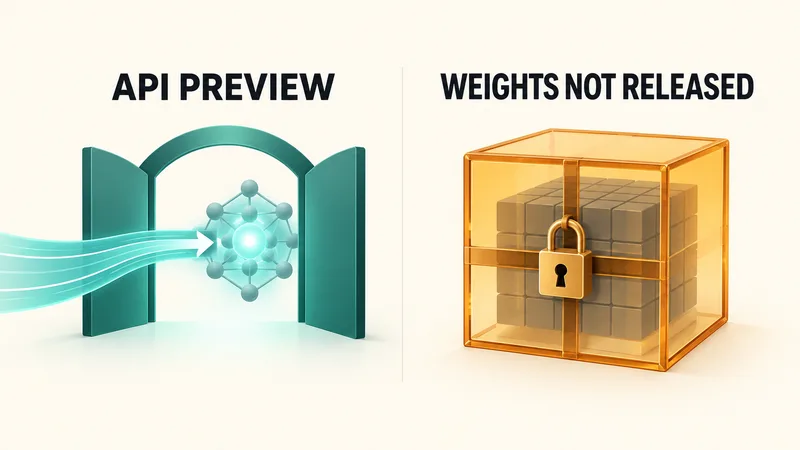
Two access details matter as much as the specification. Developers can call the model through Mistral's own API today, and the weights are promised rather than published.
What it costs
Mistral's model page lists three rates in US dollars: $1.36 per million input tokens, $0.14 per million cached input tokens and $4.18 per million output tokens. Each carries a sale price that works out to exactly half, at $0.68, $0.07 and $2.09. The page does not list an end date for the sale.
The general pricing page explains how API billing works at Mistral: batch processing halves the price, and cached input tokens cut input cost by up to 90% on repeated prompts. That page still gives its worked example with an older Mistral Large rate of $0.5 per million tokens in and $1.5 out, so the example is not ML4's rate. For a workload that resends a long prompt, the cached input number is the one that decides the bill, because a 1M token window invites exactly that pattern.
What developers can use today
The preview is live on Mistral's API. Requests go to the Chat Completions endpoint with the model name mistral-large-4, and the documentation's Python, TypeScript and curl examples all pass a reasoning_effort value of "high". Mistral lists structured outputs, function calling, document QnA, prefix, chat completions, batching, agents and conversations, and built-in tools as supported features.
Mistral says the public preview is served on the same European infrastructure that trained the model, and that ML4 will be available across multiple regions worldwide, including a European deployment the company operates end to end, independently of other digital service providers and under European law. Teams with data residency rules have a reason to check which deployment they are routed to rather than assume a default endpoint.
Nothing is downloadable yet. Mistral says the weights will be released by the end of October, and it is red-teaming the model in the meantime with cybersecurity leaders, vetted partners and state authorities, who access the same model with reduced moderation and expanded cyber capabilities. The documentation labels ML4 as open but names no license, and no model card is published. Mistral also says architecture details, additional benchmarks and its post-training methodology will follow. Until those exist, ML4 is an API model with an open-weight commitment attached.
The published numbers are Mistral's own
The launch post carries a long list of results. On coding, Mistral reports 61.7% on DeepSWE v1.1, 59.4% on SWE-Atlas-QnA and 28.3% on Terminal-Bench 4, for a combined Coding Agent Index score of 49.8%, which it places ahead of DeepSeek V4 Pro 0813 and Qwen3.8 Max. It reports 59.9% on AutomationBench, a set of 657 business workflows across Gmail, Google Sheets, Slack and Salesforce, and 1,393 Elo on AA-Briefcase. On vision, 42% on Dense 200 against 41% for GPT-6-Astra. On security, 82% on one Artificial Analysis Cyber Index test, 93% on Cybench, 93.3% attack resistance on Lakera's B3 benchmark and 1.691 on KORA.
The cyber figure arrives with an argument attached. Mistral says several leading closed models, including Claude Opus 5.5 and GPT-6 Astra, score near zero on the vulnerability-reproduction test because they refuse the task, and that defenders need a model able to prove a flaw is real. The coding figure sits beside a blind human evaluation run by Surge AI, where ML4 Preview ranked second of five models at 3.74, behind Claude Opus 5 at 4.22 and ahead of Kimi K3, GLM-5.3 and GLM-5.2.
Every number above comes from Mistral. Some of the evaluations behind them are third-party, including Surge AI's annotator study and vals.ai's legal and financial tasks, but the selection and the presentation are the vendor's, and independent replication has not happened.
What the discussion shows
A Hacker News thread about the launch drew 2,040 points and 1,212 comments. Praise centered on the vision and security results, with one commenter calling ML4 a strong defender model. Skepticism ran the other way: whether the comparisons were assembled fairly, where the model lands on third-party indices such as vals.ai, and whether it trails the closed frontier by a generation or more. One commenter asked why ML4 had not appeared on third-party routers. Another read the 50% discount as a bid to stay competitive on price.
That thread is a narrow English-language technical community sample. It shows what part of that audience argued about, not what developers generally think.
What is still unknown
The weight release date is "by the end of October" with no day attached, and the license that will govern those weights is unnamed. Architecture, post-training method and further benchmarks are promised. Whether third-party hosts will carry ML4, and on what terms, has not been announced. The sale pricing has no published end date, and nobody outside Mistral has reproduced the results.
What a developer can act on now is narrower than the announcement sounds. The preview API is available, the published rate is $1.36 per million input tokens and $4.18 per million output tokens with a half-price sale, the context window is 1M tokens, and the open-weight half of the offer is a date to watch rather than a file to download.
Sources & further reading
- Introducing Mistral Large 4Mistral AI · accessed Oct 12, 2026
- Mistral Large 4 - Mistral AI | Mistral DocsMistral AI · accessed Oct 12, 2026
- Models Overview | Mistral DocsMistral AI · accessed Oct 12, 2026
- Pricing | Mistral AIMistral AI · accessed Oct 12, 2026
- Mistral Large 4 (Hacker News discussion)Hacker News · accessed Oct 12, 2026