What the iPhone 18 Pro’s Variable Aperture Actually Changes
The iPhone 18 Pro adds a six-blade variable aperture to its 48MP main camera. Learn how f/1.48 to f/4 affects light and focus, and what one early review found.
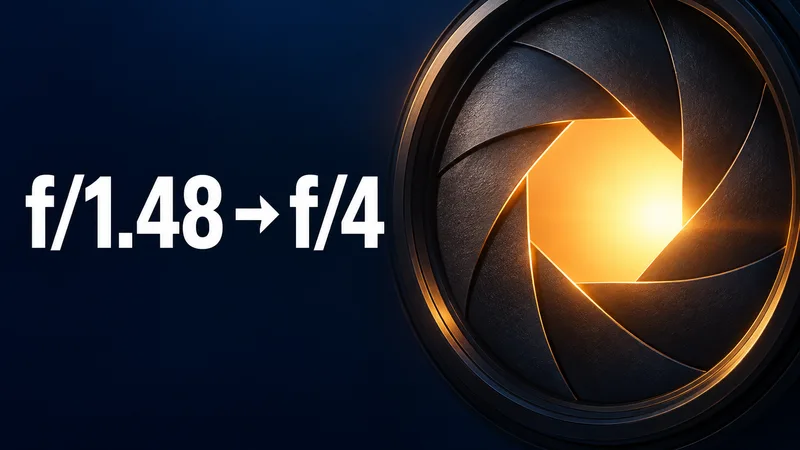
The iPhone 18 Pro went on sale September 18 with a variable aperture on its 48-megapixel Fusion Main camera. Apple's launch announcement describes a six-blade iris that changes the lens opening from f/1.48 to f/4. The Camera app offers four manual settings, and the camera can also adjust automatically.
Aperture changes how much light reaches the sensor and how much of a scene can appear in focus. That gives photographers another way to balance low-light exposure, background separation, and depth of field. The iris is a physical opening in the main camera; Apple's computational imaging pipeline still shapes the final photo.
Aperture in plain terms
A lower f-number describes a wider opening. It lets in more light and generally creates a shallower depth of field, the range of distances that appear sharp. A higher f-number describes a smaller opening that admits less light and keeps more of a scene in focus. Nikon's photography guide explains the same relationship.
Aperture works with shutter speed and ISO to set exposure. If the lens narrows in low light, a camera may need a slower shutter or higher ISO to maintain brightness. A slower shutter can blur movement, while higher ISO can add noise. The f-number alone does not determine a photo's brightness or sharpness.
The published endpoints also show the size of the range. For the same lens, the f/1.48 opening has about 7.3 times the geometric area of f/4, a difference of roughly 2.9 stops. That is an optical calculation from the f-numbers, not a promise that the saved image will be 7.3 times brighter; shutter speed, ISO, and processing affect the result.
What the settings are for
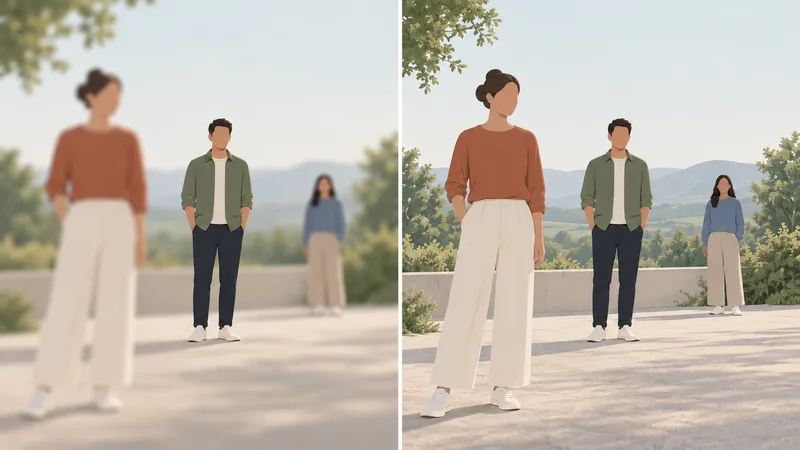
Apple says the main camera can open to f/1.48 for low-light photography, uses f/1.8 for portraits, and can stop down to f/4 to keep more people in a group in focus. Those are the company's examples, not rules for every scene. A wider opening can help when a moving subject needs more light; a smaller opening can help when subjects stand at different distances.
The trade-off depends on where the subjects are. At f/1.48, people at different distances may not all fall within the shallow focus range. At f/4, more of a group can stay in focus, but less light reaches the sensor. In dim conditions the camera may compensate with shutter speed or ISO, which can affect motion blur or noise.
The variable aperture is on the main camera. PetaPixel's review says the telephoto and ultra-wide lenses are unchanged.
Automatic and manual control
Apple's Camera app provides four manual aperture choices. PetaPixel's reviewer observed that automatic mode moved through the range continuously, while the manual controls offered four steps. Apple's Pro Controls also include shutter speed, white balance, and a histogram. Those controls let a photographer see how aperture fits with the rest of the exposure. Someone who prefers automatic operation can leave the camera to choose.
The iris changes the light before it reaches the sensor, while computational processing shapes the image after capture. The aperture adds an optical control alongside the phone's software, but it does not change which camera lens is being used. If the framing is too tight or too wide, changing aperture will not add reach; the feature does not change focal length or zoom.
What one early review found
PetaPixel says its reviewer took about 1,000 photos and several hours of video. In those tests, the widest f/1.48 setting produced softer detail toward the edges, while sharpness peaked at f/2.8. The reviewer also saw some softness at f/4 from diffraction. This is one reviewer's result, not a controlled comparison across phones or every type of scene. PetaPixel also found the aperture range more useful in video, where the reviewer said the wide-open softness was less visible at 4K. The reviewer said stopping down can help close-up video when a wide opening leaves too little in focus, while f/4 still may not be enough in bright sun with a slower shutter.
A separate r/iPhoneography discussion asked when to use f/4 and shared early reactions to the grain controls. The thread shows individual users still discussing the settings; it is not a representative product test.
How to compare the settings
For a practical check, photograph the same still scene at f/1.48, f/1.8, f/2.8, and f/4 with the same framing, light, focus point, and camera distance. To observe depth of field, place people or objects at different distances and check which stay sharp. A separate low-light scene shows how the phone balances the wider opening with shutter speed and ISO.
Apple's Pro Controls expose shutter speed, aperture, and a histogram. PetaPixel reports that the default Camera app cannot manually set ISO, so a comparison made there is an auto-exposure comparison, not an aperture-only test. The review says Preserve Settings must be enabled outside the Camera app if settings should persist between launches. Note the shutter and ISO shown with each image rather than treating the result as a controlled measurement.
Sources & further reading
- Apple debuts iPhone 18 Pro and iPhone 18 Pro MaxApple · accessed Oct 11, 2026
- Apple iPhone 18 Pro Camera Review: Small Changes, Big DifferencesPetaPixel · accessed Oct 12, 2026
- What is Aperture? The Key to Sharper, More Creative PhotographyNikon USA · accessed Oct 11, 2026
- PetaPixel iPhone 18 Pro Camera Review (Overall Positive but damn that primary lens loses some serious sharpness wide open)r/iphone (Reddit) · accessed Oct 11, 2026
- What are your thoughts on the iPhone 18’s new aperture lens and grain/film filter?r/iPhoneography (Reddit) · accessed Oct 11, 2026