An AI Solved a 370-Year-Old Cipher by Reading the Book That Hid It
Vals AI says Claude Fable 5.1 solved Thomas Urquhart's Cyphral Distich, a 64-number cipher printed in a 1653 book, by using the book's own 32 Proquiritations as the word index. A second, larger cipher was also decoded, with nine letters still uncertain.
What happened
A language model appears to have solved a cipher that had resisted attempts for roughly 370 years, and it did so in under an hour.
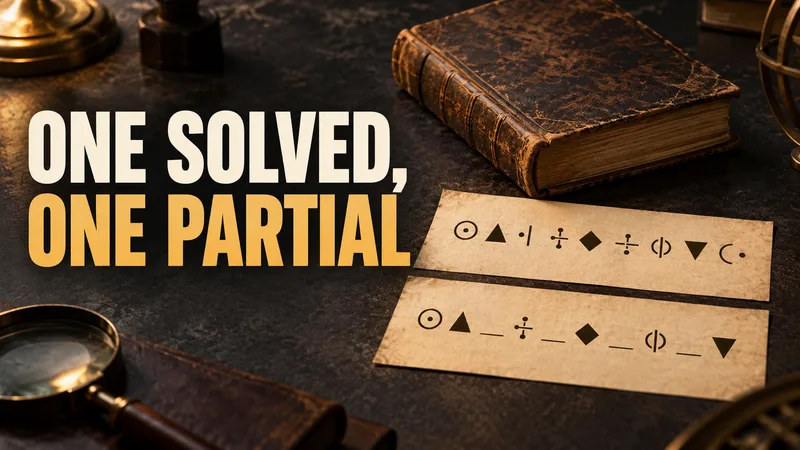
The cipher is the Cyphral Distich, printed at the end of Sir Thomas Urquhart's Logopandecteision: two lines of 32 numbers each, with no explanation of what they mean.
Vals AI, a firm that runs model evaluations, gave Claude Fable 5.1 an open-ended task to solve an unsolved cipher. Its write-up says the model reached a solution after 44 minutes and 176,000 tokens, with no human interjections, and the plaintext is a two-line royalist prayer for Charles II.
The clue nobody used
The cipher sits immediately after Urquhart's 32 Proquiritations, and Urquhart makes a point of stressing that number. The poem accompanying the cipher also promises that an honest reader will find in it "his own heart's wishes, and the Author's minde", and the Proquiritations themselves end with formulations such as "is the desire", "wish" or "hope of".
Those three details supply the key: 32 Proquiritations, 32 numbers per cipher line, and a poem about wishes.
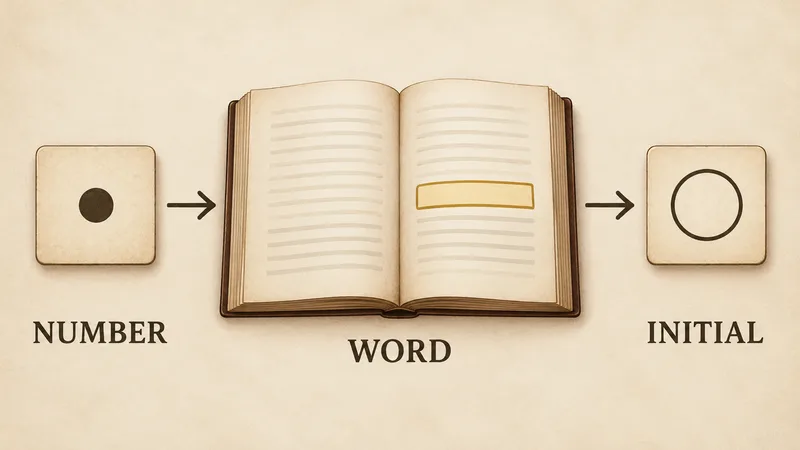
The rule is simple. For the i-th number in a cipher line, go to the i-th Proquiritation, use the number as a word index, and take the first letter of that word. Repeat 32 times per line and the message appears:
O GOD UPHOLD KING CHARLS THE SECOND AND MAKE HIM THE SUPREME RULER OF THIS LAND
Earlier attempts had assumed the key was external, either a cipher alphabet or a mapping of numbers to letters that had to be reconstructed from outside the text. The key was the book itself.
Why the result holds up
The solution is self-verifying in a way many claimed cipher solutions are not. Each line yields exactly 32 letters. The two lines rhyme on "and" and "land", which is what a distich is meant to do. The content also fits the author: Urquhart was a committed Royalist, so a hidden prayer for Charles II is consistent with his politics.
The write-up places the puzzle in a longer history: it was posed as an open problem in Notes and Queries in 1899, appeared in 20th-century cryptography literature, and was later listed by the historical-cipher researcher Klaus Schmeh among his Top 50 unsolved encrypted messages.
The second cipher, and where it breaks
Urquhart left a larger puzzle in the same style. The Cyphral Octastich, printed in The Jewel in 1652, has 285 numbers instead of 64. Vals AI says the model decoded this one as well, with nine letters still uncertain.
The rule is a variation on the same idea. The Jewel has 284 numbered pages, and the k-th number indexes a word on page k, with the first letter of that word as the output.
The write-up is candid about the problems. Line four encodes an abbreviated form that may be a slip or a deliberate contraction. Line five contains a run of letters that does not resolve into English, and several hypotheses were tested without success. From one position onward, every number keys to the previous page, which suggests a duplicated page reference or a printing error.
Then the practical limit: no free page images of the 1652 Jewel are available. The team checked Google Books, HathiTrust, the Internet Archive and the National Library of Scotland. Confirming the uncertain positions needs a physical copy or a specific 1983 edition.
What the experiment does not show
This was a vendor-run experiment, published by Vals AI about a model it evaluates. No independent cryptanalyst has reproduced the solution, and the nine uncertain letters are the kind of detail independent review would need to settle.
The post also states that other frontier models were tried over several months without a verified solve. That is a claim about the author's own testing, not a benchmark result.
Two more caveats come from the write-up itself. The experiment deliberately avoided ciphers that already have solutions or that could support many plausible answers, which is a sensible filter and also means the task was selected for tractability. The post names Kryptos K4 as probably too difficult for current models, which sets a boundary on the result.
The claim is not that the model performed superhuman cryptanalysis. The post argues the opposite: the answer was simple in hindsight, and the model kept looking until it found it.
Why this kind of task matters
Historical ciphers and archival puzzles have usually been limited by human attention. Someone had to spend days reading obscure material, testing unpromising ideas and tracing references through old books.
If a model can run that search cheaply, the constraint changes. That does not make every unsolved cipher solvable, and it does not tell you when a proposed solution is correct. It changes who can afford to try, and it makes the verification step the harder half of the work.
Sources & further reading
- Claude Fable 5.1 Solves the Cyphral DistichVals AI · accessed Oct 12, 2026
- Hacker News story search snapshot (30-day window)Hacker News (Algolia API) · accessed Oct 12, 2026